

Food marketing influences consumer choices at every level, from the cereal a six-year-old begs for in aisle three to the functional beverage a 30-year-old adds to cart after scrolling TikTok. In the United States, the food and beverage category leads all others in digital advertising spend. U.S. food marketing budgets focus on nutrient-poor products; the vast majority of promotional dollars back fast food, sugary soft drinks, and ultra-processed snacks rather than fruits, vegetables, or whole grains.
The consequences are measurable. Ultra-processed foods now supply over 57% of daily caloric intake for U.S. adults, up from 53.5% in 2001-2002. Meta-analyses link high intake of these products to elevated risks of cardiovascular disease, type 2 diabetes, obesity, and certain cancers. Childhood obesity rates among Americans aged 2-19 hover near 20%. Food marketing sits at the center of these outcomes because it shapes consumer behavior, food choices, and healthy eating habits at scale.
At MAVRK Studio, we work as a food and beverage launch studio helping funded founders and established CPG companies build brands that are both commercially strong and aligned with real consumer needs. We see both sides of the food marketing industry every day: the public health challenges it creates and the commercial opportunities it offers to brands willing to do it well.
This article covers both dimensions. We walk through how food advertising shapes public health outcomes (food labels, ultra-processed foods, childhood obesity) and how the commercial machinery works (brand positioning, packaging design, product launches, retail readiness). Whether you are launching a product, relaunching a line, or trying to understand why certain food products dominate shelves, this is the reference you need.
What Is Food Marketing? From Farm to Shelf-Ready Brand
Food marketing covers every activity that moves a food product from producer to consumer. That includes market research, product development, brand positioning, pricing, packaging, distribution channel selection, and promotion. Effective food marketing requires understanding consumer needs and building brand identity before spending a dollar on advertising.
The term spans two distinct worlds. Agricultural marketing deals with commodities and bulk ingredients: wheat futures, dairy supply contracts, producer-to-wholesaler relationships. Food industry marketing refers to finished, branded food products and beverages sold to end consumers. The goals diverge. Agricultural marketing optimizes volume and unit price. CPG marketing builds differentiation, brand equity, and repeat purchase behavior. Brands create value and differentiate products in food marketing through positioning, packaging, and storytelling.
Three concepts anchor every food marketing strategy. Brand positioning defines who the product is for, what it offers, and why it differs from competitors. A value proposition bundles functional, emotional, and symbolic benefits against cost. Channel strategy determines where a product sells: grocery stores, ecommerce, foodservice, delivery apps. Each channel carries different margins, reach, and brand-control trade-offs.
Consider the difference between a 2024 ready-to-drink adaptogenic energy beverage and a legacy 1990s soda brand. The energy beverage targets wellness-oriented consumers aged 25-40, sells through health-focused retailers and DTC, uses social media platforms for education-driven content, and lists five recognizable ingredients. The soda brand targets everyone, sells everywhere, runs mass-media television advertising, and competes on taste and price. Food marketing involves a mix of traditional and digital techniques to attract customers; the blend depends on who you are selling to and where they shop.
The Evolution of Food Marketing and Food Advertising
In the 1980s and 1990s, food companies poured advertising budgets into children’s television programming. Cereal brands, fast food chains, and candy manufacturers saturated Saturday morning cartoons with mascots, jingles, and toy tie-ins. Those campaigns built brand loyalty in consumers before they could read a nutrition label, and the effects rippled through decades of purchasing behavior.
Between 2007 and 2010, social media marketing reshaped the landscape. Facebook, Twitter, and YouTube gave food brands direct access to consumers without buying TV slots. Early experiments with sponsored content and influencer seeding proved that a well-placed recipe video could outperform a 30-second commercial at a fraction of the cost. Food brands began utilizing multiple advertising channels including digital and traditional formats, running parallel campaigns across TV, search, and social.
The post-2020 period accelerated three shifts. Ecommerce and delivery platforms (Instacart, DoorDash, Shopify storefronts) became primary purchase channels. Retail media networks like Amazon Ads and Walmart Connect turned retailers into ad platforms. AI-personalized marketing now delivers hyper-targeted promotional content and product recommendations based on browsing history, purchase patterns, and location data, and emerging AI in the food industry applications are reshaping how brands forecast demand and optimize innovation cycles. Data-driven marketing helps food companies analyze trends and consumer behavior to allocate spend where it converts.
Self-regulation changed children’s exposure. The Children’s Food and Beverage Advertising Initiative (CFBAI) updates in 2014 and 2020 reduced food ad exposure on children’s TV programming from roughly 4,600 ads per year for ages 2-5 in 2013 to about 1,000 per year by 2022. But the products still advertised remain loaded with saturated fat, sodium, and added sugars. The channel shifted; the nutritional quality of the promoted products did not.
Food Marketing, Consumer Behavior, and Food Choices
Consumer behavior in the food sector operates on a simple tension: people say they want to eat healthier, but they buy what is cheap, fast, and familiar. Utility theory explains this gap. Taste, convenience, cost, and social acceptability drive real purchasing decisions. Stated preferences for health often lose when a price premium or extra preparation time enters the equation. Price sensitivity is acute among low-income households, where food marketing messages for value-sized snack multipacks land with more force than campaigns for organic produce.
Price promotions prove the point with data. A clinical trial called the Supermarket Healthy Eating for Life study showed that a 20% price reduction on fruits and vegetables increased fruit purchases by 35% and vegetable purchases by 15% over baseline. The implication: consumer demand for healthy food exists, but it responds to price signals more than to health messaging alone. Effective marketing can influence consumer behavior towards nutritious choices when it addresses the real barriers.
Consumer loyalty is influenced by effective branding strategies that go beyond a single touchpoint. Segmentation matters. Eco-conscious shoppers respond to organic, regenerative, and sustainability claims. Budget-constrained families gravitate toward value packs and familiar flavors. Parents look for kid-friendly packaging and flavors. Ethnic and cultural segments seek ingredients and taste profiles that reflect their food traditions. Each segment requires different marketing techniques, different messaging, and different proof points.
Food marketing uses emotional connection, sensory appeal, and digital reach to shape consumer preferences. Sensory marketing engages sights, sounds, smells, and tastes to evoke emotional responses; think of the sizzle sound in a burger commercial or the crunch amplified in a chip ad. Food marketing often employs sensory appeal to create cravings that override rational nutrition calculations. Research links heavy exposure to unhealthy food marketing with increased caloric intake: one umbrella review found dose-response risk ratios for obesity of approximately 1.39 when comparing the highest versus lowest quartiles of ultra-processed food intake. Food marketing impacts consumer purchasing habits at a population level, not just an individual one.
Economic Drivers: Why Unhealthy Food Marketing Dominates
Ultra-processed foods start with cheap raw materials: refined grains, sugars, seed oils. Industrial processing, flavor engineering, branding, and packaging turn those low-cost inputs into high-margin products. Gross margins for branded soft drinks and packaged snacks often range from 25% to 40% or higher, depending on brand and channel. Fresh produce margins are tighter; perishable items carry higher waste, costlier cold-chain logistics, and slower inventory turns. The margin gap explains where the advertising dollars go.
U.S. food manufacturers spend most marketing dollars on nutrient-poor products because those products generate the returns that fund the spending. Food marketing budgets heavily promote unhealthy food options over whole foods, fruits, and vegetables. The cycle is self-reinforcing: higher margins fund more advertising, which drives more consumption, which funds more advertising. About 20,000 new food products launch annually in the U.S., and a large share fall into snack, candy, and beverage categories where competition for attention is fiercest.
Shareholder expectations intensify the pattern. Public food companies report quarterly, and growth metrics favor products with high repeat purchase rates and premium line extensions. Flavored, engineered, indulgent products deliver those metrics more reliably than simple whole foods. Food marketing budgets often prioritize unhealthy food promotions because the underlying business model depends on habitual consumption of high-margin SKUs. The tension between profit-driven food advertising and public health goals like reducing obesity and diet-related disease is structural, not incidental.
Ultra-Processed Foods (UPFs) and Health: The Marketing Connection
Ultra-processed foods, as defined by the NOVA classification system, are formulations with little or no whole food content. They contain industrial additives like emulsifiers, flavor enhancers, colorings, and preservatives. Common examples include flavored breakfast cereals, packaged cookies, energy drinks, frozen pizzas, and mass-produced snack chips.
Since 2018, meta-analyses have linked high UPF intake to a risk ratio of approximately 1.50 for cardiovascular disease mortality when comparing highest to lowest consumption groups. Evidence rated “convincing” also connects UPF intake to type 2 diabetes, obesity, and certain cancers. Mental health outcomes show associations as well, though the evidence base is still developing.
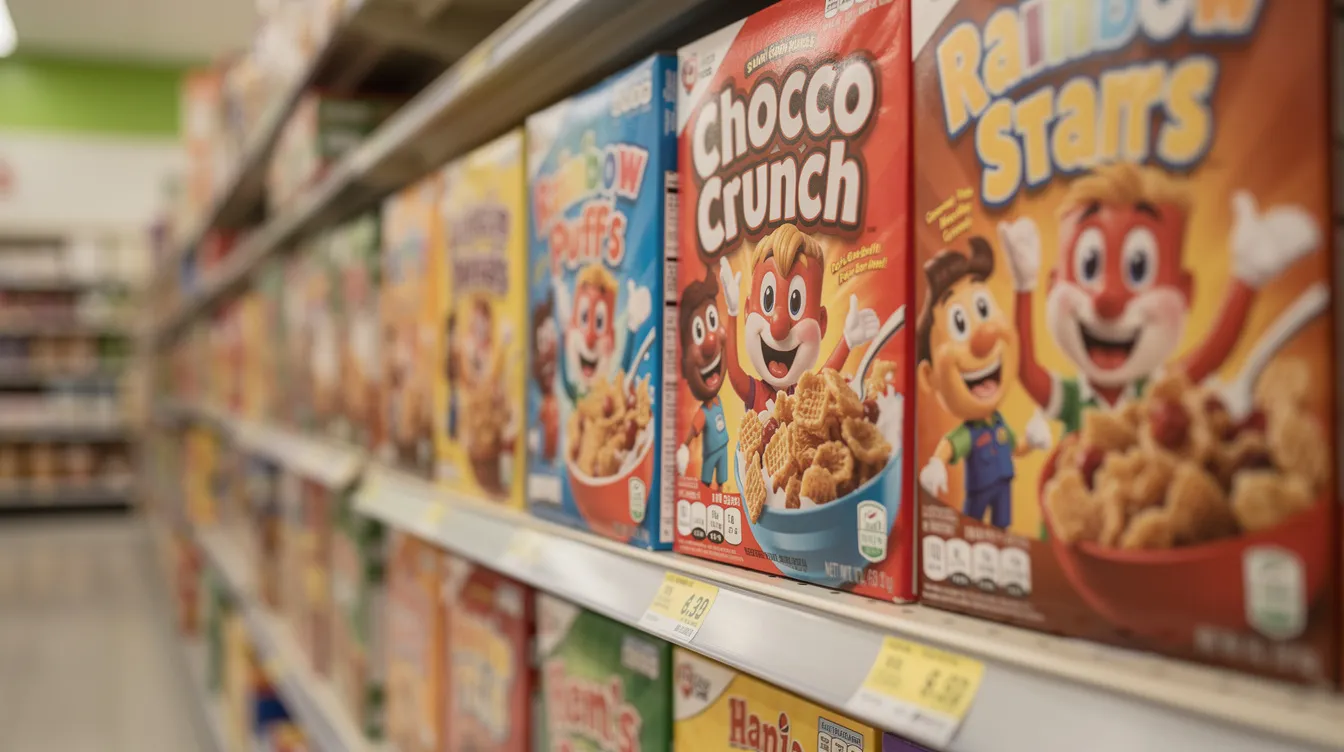
Packaging and flavor engineering make UPFs the convenient default. Bright imagery, cartoon mascots, and health claims (“light,” “protein,” “immune”) appear on packages designed to signal healthfulness. In-store promotions (endcap displays, multi-buy offers, checkout placement) are nearly always more aggressive for these products than for whole foods. Low-income households often default to UPFs because they are cheap, shelf-stable, and require minimal preparation.
Food marketing can promote healthier food options when the economic incentives align. In 2010, broccoli sales increased by 8% after an ad campaign, proving that produce responds to marketing investment. The problem is not that advertising fails for healthy food; the problem is that healthy food rarely receives the investment. Food marketing can educate consumers about nutritional value when brands and public health organizations commit resources to the effort.
To spot a UPF, start with the ingredients list. Products with more than five to seven ingredients, especially those containing unfamiliar chemical names (carboxymethyl cellulose, TBHQ, modified starch), are likely ultra-processed. If sugar or a sugar variant appears among the top three ingredients, that is another signal. Flavor enhancers and artificial colors are common markers. Minimally processed alternatives list whole ingredients: frozen vegetables without sauce, canned beans in water, plain oats.
Food Marketing and Childhood Obesity
Food marketing often targets children due to their purchasing influence. The industry calls it “pester power”: a child who recognizes a brand from a commercial asks a parent to buy it, and the parent often complies. The lifetime value of a consumer acquired at age five is high, making children a prime target market for food companies.
In 2006, U.S. companies spent $10 billion marketing to youth. Children saw an estimated 4,787 food ads on TV in 2013, the majority for fast food, sugary drinks, and snacks. By 2022, exposure on children’s TV programming dropped to roughly 1,000 ads per year for ages 2-5, but 60-70% of those remaining ads still promoted products high in saturated fat, sodium, or added sugars. Television ads influence children’s food preferences, and the shift to digital channels has not reduced overall exposure; it has redistributed it.
Most children under 8 cannot understand advertising’s persuasive intent. They process a cereal commercial or a YouTube influencer’s snack review as straightforward information, not as a paid pitch. Cartoon characters on packaging influence children’s food choices; studies show kids rate identical food as tasting better when it carries a familiar character. Marketing appears across cartoons, mobile games, social media posts, school sponsorships, and product packaging designed with fun shapes and bright colors.
Evidence from experimental settings shows that children eat more immediately after watching a snack commercial. Longitudinal studies link heavier exposure to preferences for high-sugar, high-fat foods. Obesity prevalence among U.S. children aged 2-19 sits near 19-20%, with steeper rates among low-income and certain ethnic groups. Children’s health is directly affected by the food marketing strategies that surround them from toddlerhood.
Food Labels, Food Labeling, and Misleading Nutrition Claims
Food labeling informs consumers about product characteristics, but the system has gaps that food companies exploit. The FDA’s Nutrition Facts Panel covers calories, macronutrients, vitamins, and minerals. USDA Organic certification regulates organic claims. These are mandatory and enforceable. Terms like “natural,” “light,” “immune support,” “keto,” and “no added sugar” operate in a gray zone where regulation is looser and consumer confusion is higher.
Misleading labels can confuse consumers about food properties. “No added sugar” may appear on a product sweetened with fruit juice concentrate, which delivers the same free sugars. “Light” sometimes refers to color or texture, not calorie content. “Natural” has no formal FDA definition. “Immune support” is not regulated with the rigor applied to drug claims. These phrases create health halos, leading consumers to believe a product is healthier than its nutrition profile warrants. Label design influences consumer perceptions and choices; a green label with leaf imagery can shift perception even when the product inside is loaded with added sugars.
The FDA issued a proposed rule in January 2025 to require front-of-package “Nutrition Info” boxes showing levels of saturated fat, sodium, and added sugars with interpretive descriptors (“Low,” “Med,” “High”). Compliance would be required within three years of the final rule for firms with over $10 million in annual sales; four years for smaller businesses. The FDA is also updating its definition of “healthy” to align with the 2020-2025 Dietary Guidelines. Health and functional positioning highlights attributes like organic or gluten-free, but those claims will face tighter scrutiny as new rules take effect.
Functional and wellness-driven positioning align products with health benefits, and this trend is growing across the food industry. For readers navigating labels now: read the ingredients list before the front-of-pack claims. Check the serving size against the package size. Look for added sugars under the nutrition panel. Treat ambiguous words (“wholesome,” “clean,” “pure”) as marketing signals, not nutritional guarantees.
Retail Influence: Supermarket Catalogues, Product Placement, and Shelf Strategy
Supermarket catalogues, circulars, and retail media ads promote high-margin food products because those products fund the promotions. Snacks, sugary beverages, and processed foods appear on the front page of weekly flyers because manufacturers pay slotting fees and promotional allowances for that placement. Packaging acts as a key marketing tool influencing consumer decisions at the point of purchase, and partnering with a CPG packaging design agency can turn that moment into a sustained brand advantage.
Inside the store, the architecture of influence is physical. Eye-level shelf placement captures the most attention; brands pay for it. Endcap displays at aisle ends generate impulse purchases. Checkout aisles line up candy, gum, and single-serve drinks. Sample booths create taste experiences that bypass rational evaluation. Visual design and packaging communicate quality and brand ethos on crowded shelves, and visual packaging using clear labels and colors helps products stand out against competitors with larger budgets.
Several countries have acted on this. Chile bans placement of unhealthy foods near children’s eye level and prohibits cartoon characters on packaging for products exceeding nutrient thresholds. The UK restricts multi-buy promotions and prominent shelf space placement for HFSS (high fat, salt, sugar) products. These policies demonstrate that retail environments can be reshaped through regulation.
For a small CPG brand competing in grocery stores, the path forward involves retail-ready packaging with clear positioning (low sugar, plant-based, local), strong shopper marketing materials (point-of-sale signage, sell sheets for buyers), and a packaging design strategy that works at both shelf scale and thumbnail scale. Smart brands invest in packaging that does the selling when no salesperson is present.
Digital Food Marketing, Social Media, and Behavioral Advertising
Digital food marketing includes social media ads, influencer content, user-generated content, email marketing, search ads, and platform-specific formats like TikTok short videos, Instagram Reels, and YouTube pre-rolls. These formats often blur the line between content and advertisement, making food advertising harder to recognize, especially for teens and young adults.
Behavioral advertising uses browsing history, purchase data, and location to micro-target food ads. A fast food chain can run geofenced ads within a one-mile radius of a high school. A delivery app can retarget users who browsed pizza at 10 p.m. but did not order. Short-form video content on platforms like TikTok drives consumer engagement because algorithms reward visually appealing, shareable food content. Influencer collaborations showcase recipes and drive impulse purchases through affiliate links and swipe-up prompts embedded in what looks like organic content.
Radical transparency appeals to consumers by revealing ingredient origins through QR codes on packaging that link to sourcing stories, farm videos, and lab test results. This tactic works because it counters the distrust that opaque marketing messages generate. Brands using it report higher repeat purchase rates among health-conscious segments.
A post-2021 example: several functional snack and beverage brands used TikTok creator challenges to generate rapid viral growth, leading to product sell-outs within days of a video gaining traction. The mechanism is simple: a creator posts a recipe or taste test, followers share it, the algorithm amplifies it, and demand spikes before supply can respond. For a deeper look at how food and beverage brands can build a social media presence, channel-specific tactics matter more than broad awareness plays.
Privacy and ethics remain unresolved. FTC rules require disclosure in influencer partnerships, but enforcement is inconsistent. Children have less ability to distinguish sponsored posts from genuine recommendations. Location-based targeting of low-income communities with fast food ads raises ethical concerns about equitable access to healthy food.
Building a Food or Beverage Brand: Foundations Before Marketing
Before spending on food advertising, a founder needs clear answers to five questions. What is the product (category, formulation, flavor, nutrition profile)? Who is the target market (demographics, psychographics, purchase occasions)? Where will it sell (retail, ecommerce, foodservice, delivery)? What will the price be (cost structure, margin targets, competitive benchmarks)? How will it stand out from other brands?
MAVRK Studio’s 90-day launch philosophy starts with category validation before the bulk of branding or marketing spend, then moves into a structured branding system for food and beverage that aligns identity across every touchpoint. That means shelf audits in retail stores, competitive ecommerce reviews, ingredient and packaging comparisons, and consumer research to identify positioning gaps. A founder who skips validation risks building a brand that looks good but occupies no distinct space in the consumer’s mind. For guidance on how to build a beverage brand from scratch, validation is the first checkpoint.
Production realities constrain food marketing strategies. A fresh, refrigerated product requires cold-chain logistics, shorter shelf life, and higher waste margins. A shelf-stable product needs different packaging materials and preservative strategies. Co-packer readiness (minimum order quantities, compliance certifications, label approval timelines) shapes what a brand can promise on its packaging and when it can deliver to retail. These constraints are not afterthoughts; they determine which marketing claims are credible and which channels are viable.
Crafting Food Marketing Strategies for CPG Launches and Relaunches
A modern CPG food marketing strategy combines clear positioning, channel strategy, pricing and promotion architecture, launch content, and paid media testing, supported by CPG advertising strategies for F&B brands that connect creative, targeting, and measurement. Each element connects to the others. Positioning defines the message. Channel strategy determines where the message appears. Pricing and promotions (including limited-time offers that create urgency and excitement around products) drive trial. Launch content (photography, video, brand storytelling) gives the message a visual form. Paid media testing validates which messages convert at what cost.
MAVRK Studio builds integrated launch plans that connect packaging design, ecommerce design, photography, and paid media into one coherent system through a specialized food and beverage marketing agency model. This approach prevents the common failure mode where a founder hires separate vendors for branding, packaging, web design, and marketing, then discovers the assets do not align. For a deeper look at how food and beverage marketing techniques work in practice, integration is the throughline.
Retail readiness means having proper UPCs, FDA-compliant labels, packaging specs that meet co-packer requirements, and sell sheets formatted for brokers and distributors. Investor readiness includes sales forecasts, proof points (pre-orders, social proof, sampling data), and a pitch deck that reflects the brand’s market positioning. Both types of readiness must be built in parallel with creative assets, not bolted on after launch.
A practical 90-day roadmap: Weeks 1-4 cover customer research, category validation, and positioning strategy. Weeks 5-8 focus on branding, packaging design, photography, video content, and ecommerce setup. Weeks 9-12 execute launch with promotions, paid media testing, optimization, and distribution placement. Limited-time items can create urgency during the launch window, driving initial trial and retail velocity.
Restaurant and Foodservice Marketing: Different Game, Same Principles
Restaurant marketing competes on experience, service, menu, and location rather than shelf space. The unit economics differ from CPG: margins depend on table turns, average check size, and repeat visits rather than unit volume and retail velocity. Customer loyalty builds through in-person interactions, not packaging.
Key channels include local SEO, Google Maps optimization, food delivery apps, loyalty programs, and partnerships with nearby gyms, offices, or community organizations. Experiential marketing involves interactive events and tastings to enhance customer engagement, and restaurants have a natural advantage here because the product is experienced in real time. For founders considering how to open a restaurant and build demand before doors open, a pre-launch campaign is not optional, and a specialized restaurant branding company can help translate concept and menu into a coherent guest-facing identity.
Pre-launch strategy includes soft openings, invite-only tastings, influencer dinners, and press previews. Building an email list and social media community before opening generates pent-up demand that translates to high traffic in the first weeks. MAVRK Studio supports restaurant launches with the same integrated approach used for CPG: brand identity, menu positioning, photography, and launch content tailored to local audiences.
Case Example: Pre-Launch Food Marketing for Restaurants (Spiced Black)
Spiced Black is a single-location restaurant that reached over 20,000 social media followers in its first year. That level of following came from a disciplined pre-launch campaign, not from paid advertising at scale. MAVRK Studio supported the launch with a strategy built around community, content, and influencer activation.
Before the doors opened, the team arranged influencer dinners that gave local creators first access to the menu, the space, and the story. Those dinners produced a wave of organic content; photos, reviews, Reels, and Stories that reached local audiences who already trusted the creators posting about it. Behind-the-scenes content during the build-out (menu testing, interior construction, ingredient sourcing) kept followers engaged during the months before opening.
The team collected emails and SMS contacts through soft launch events and preview invitations. Social content and real-life activations (local food festivals, pop-ups) worked together. Each IRL touchpoint funneled people to digital channels, and digital channels promoted the next IRL event. Opening week traffic exceeded what the location’s size would typically support, driven by pent-up demand. Local press picked up the story because visual content and influencer interest gave journalists material to work with.
The case demonstrates a repeatable principle: pre-launch content planning, structured influencer partnerships, and community building generate demand that a restaurant can sustain. This does not require a national advertising budget. It requires time, planning, and a team that coordinates social, content, and IRL activations into one system.

Brand Positioning and Differentiation in the Food Industry
Brand positioning answers three questions: who is this for, what problem does it solve, and why is it different? In crowded food categories where shelf space is limited and attention is shorter, positioning is the difference between a product that sells and one that sits.
Successful food brands create emotional connections through unique brand stories and personality. A heritage spice brand with PDO certification tells a story rooted in place and tradition. A climate-positive frozen meal brand tells a story about regenerative agriculture and carbon reduction. A low-sugar kids’ yogurt brand tells a story about giving parents a product they feel good about. Each position is specific, defensible, and hard for competitors to copy. Nostalgia marketing taps into emotional connections by modernizing classic flavors; a heritage brand reformulating a grandmother’s recipe for retail distribution is a concrete example.
Consumers often remember only two brands per category when shopping under time pressure. Mental availability, the likelihood that a brand comes to mind during a purchase occasion, depends on distinctive assets: a recognizable name, consistent colors, a unique packaging form, a memorable brand story. Brands that own these assets get into the two-slot consideration set. Those that do not get overlooked regardless of product quality. For a deeper framework, CPG branding strategy covers the mechanics of building distinctiveness, and ongoing insights from a creative agency focused on food and beverage can keep those strategies current with design and digital trends.
Packaging Design, Food Labels, and Shelf-Ready Branding
Packaging is the last ad a consumer sees before buying and the first asset a shopper encounters when browsing an ecommerce listing. It must balance regulatory food labeling requirements (nutrition panel, allergen statements, net weight) with a visual hierarchy that communicates brand, benefit, flavor, and proof points in under three seconds.
Design choices signal category and quality. Green and earth tones cue health and natural positioning. Metallic or bold colors signal indulgence and energy. Clean typography reads as premium; busy layouts read as mass market. Structure matters too: resealable pouches suggest freshness and convenience, clear windows imply transparency, and unusual shapes attract attention on a shelf of uniform boxes. Milk in glass packaging is perceived as healthier than carton milk, even when the contents are identical. Perception is not separate from packaging; it is driven by it.
A cereal box with a clean label and a front-of-pack badge (“Low Sugar,” “High Protein”) nudges perception toward health without requiring the consumer to flip the box and read the nutrition panel. A beverage can with minimalist design reads as a better-for-you option next to a competitor with a cluttered label. MAVRK Studio approaches retail-ready packaging as part of an integrated 90-day launch, syncing packaging design with ecommerce thumbnails, photography, and brand identity so that visuals stay consistent across shelf, website, and social content.
Community-Led Food Marketing: Beyond Social Media Followers
Community is now a core asset for food and beverage brands. Buyers, distributors, and brokers look at engaged communities as proof of demand. An email list with strong open rates, a social account with high engagement, and event attendance records carry more weight in a retail pitch than a follower count with low interaction. Community goes beyond vanity metrics on social media platforms.
Owned channels form the foundation. Email lists and SMS contacts give a brand direct access to high-intent consumers without relying on algorithm changes. Brands can build these lists early through pre-order campaigns, sampling events, tastings, and value-driven content like recipes, nutrition education, and ingredient origin stories.
IRL activations make the brand feel real. Pop-ups at local markets, product demos in stores, community tasting events, and collaborations with local gyms or cafes create face-to-face touchpoints that digital channels cannot replicate. These activations convert skeptics into advocates and give the brand stories to share across social and email.
User-generated content acts as social proof and enhances brand trust. Structured UGC programs (where creators are briefed on brand values, given clear guidelines, and required to disclose sponsorship) feed all other marketing channels. A founder’s recipe recreated by 50 customers on Instagram generates more credibility than a polished brand video. The key is structure: random seeding wastes budget, while intentional partnerships scale.
Email, Content, and Community Funnels for F&B Brands
A practical funnel for food and beverage brands flows through five stages: discovery (social media, IRL events, influencer marketing), capture (email and SMS signups), nurture (recipes, education, origin stories, offers), conversion (DTC purchases, retail prompts), and advocacy (UGC programs, referrals). Each stage feeds the next.
Content themes that perform include healthy eating tips, meal prep ideas featuring the product, caregiver-focused content addressing childhood obesity concerns, and behind-the-scenes stories about sourcing and production. These themes build trust over time rather than pushing a single transaction.
Email campaigns can support retail (“Now at Whole Foods,” “Find us at your local co-op”) and drive restaurant traffic (“This week’s specials,” “Reserve for Friday,” “New seasonal menu”). Gamified loyalty programs engage younger demographics with interactive experiences like points for social shares, recipe submissions, or event check-ins. MAVRK Studio’s integrated launch system develops content, photography, and ecommerce design together so every funnel stage has the assets it needs.
Influencer Marketing, UGC, and Modern Social Proof
Influencer and UGC-driven food marketing works because it feels native. A creator’s recipe video on TikTok looks like content, not an ad. Visual storytelling in platform-native formats (Reels, Shorts, TikToks) outperforms polished brand-produced commercials for engagement and trust among 18-34-year-olds.
Micro-influencers (10,000-100,000 followers) and nano-influencers (1,000-10,000 followers) often outperform macro creators for food and beverage brands. Their engagement rates are higher, their audiences trust them more, and their content feels more authentic. For restaurants and niche CPG brands, local creators who eat at the spot or use the product in their own kitchens deliver results that national campaigns cannot match.
Specific activations include influencer dinners (as MAVRK Studio executed for Spiced Black), creator recipe challenges using the brand’s product, paid UGC repurposed for ad creative, and affiliate programs tied to DTC or delivery platforms. For a strategic guide to food influencer marketing, choosing the right tier of creator for the brand’s stage and budget is the first decision.
Compliance is non-negotiable. FTC rules require “#ad” or “#sponsored” disclosures. Platform policies add additional requirements. Trust erodes quickly when disclosures are absent or when health benefits are overstated. Social media influencers who are transparent about partnerships maintain credibility; those who hide sponsorship burn trust for the brand and themselves.
Healthy Eating, Social Responsibility, and “Good” Food Marketing
Healthy food marketing campaigns succeed when they attach to measurable consumer benefits rather than vague aspirational messaging. In 2010, broccoli sales increased by 8% after an ad campaign that treated produce like a branded product with personality and purpose. The campaign proved that food marketing can promote healthier food options when the investment and creativity match what the food industry deploys for snacks and soft drinks.
Brands emphasize sustainability and ethical sourcing in response to consumer values. Certifications (USDA Organic, Fair Trade, Regenerative Agriculture) give claims credibility. Sustainability and ethical storytelling emphasize farm-to-table traceability and fair trade practices. A low-sugar kids’ line partnering with pediatric dietitians and non-profit health organizations earns trust that a health claim on a box cannot. A plant-based frozen meal brand measuring and disclosing its carbon footprint appeals to consumers who verify claims.
Greenwashing and healthwashing are real risks. A product labeled “natural” with 30 grams of added sugar per serving is healthwashing. A brand that claims “sustainable packaging” while using non-recyclable materials is greenwashing. Consumer demand for transparency is rising, and brands caught making unsupported claims lose social media credibility fast.
Responsible brands can still win commercially. Trend reports from industry analysts show “better for you” category growth outpacing indulgence in several food segments. Brands aligned with long-term consumer preferences toward healthier, more sustainable diets build equity that compounds rather than erodes.
B2B Food Marketing: Selling Ingredients, Private Label, and Services
B2B food marketing targets restaurants, food manufacturers, retailers, and food service companies rather than end consumers. The marketing techniques differ: trade shows, chef-targeted campaigns, technical documentation, sample programs, sales decks, and LinkedIn content aimed at procurement and R&D decision-makers.
Consumer trends travel upstream. Rising consumer demand for plant-based protein drives ingredient suppliers to develop novel protein isolates and concentrates. Low-sugar trends push sweetener companies to market alternatives like allulose and monk fruit extract. Sustainability expectations force packaging suppliers to offer compostable and recyclable options and to document fair labor practices throughout their supply chains.
A plant-based protein supplier that publishes peer-reviewed technical documentation, partners with chefs to develop restaurant menu items, and presents at food expos builds credibility that a sales call alone cannot. A spice blend manufacturer that shares origin stories, provides clean-label formulations, and collaborates with food service operators on signature dishes positions itself as a partner rather than a vendor. These approaches mirror CPG brand-building principles applied to a B2B context.
Regulation, Ethics, and the Future of Food Marketing Policy
U.S. food marketing regulation sits across multiple agencies. The FDA oversees nutrition labeling and health claims. The USDA regulates meat, poultry, and organic certification. The World Health Organization influences global frameworks for marketing to children, food labeling, and health claim standards. The FTC enforces truth-in-advertising rules and influencer disclosure requirements.
Current debates center on three areas. Front-of-pack warning labels, modeled on systems in Chile and Mexico, would give consumers immediate visual cues about saturated fat, sodium, and added sugar content. Sugar taxes remain politically divisive; jurisdictions that have implemented them (Philadelphia, Berkeley, several countries) report modest reductions in sugary beverage consumption. Restrictions on advertising unhealthy food to children are expanding from television advertising to digital platforms, with proposed rules covering social media campaigns, gaming, and school-based marketing.
Ethical concerns run deeper than compliance. Targeting vulnerable populations (children, low-income communities, communities of color) using behavioral or AI targeting raises questions that regulation has not fully addressed. Neuromarketing research that optimizes packaging and flavoring to encourage overconsumption sits in an ethical gray zone. Blending content with advertising in ways that obscure persuasive intent, particularly on social media platforms where teens cannot distinguish sponsored from organic content, erodes public trust.
Emerging policies will reshape food marketing strategies. If front-of-pack rules finalize, many existing products will need reformulation or face consumer backlash when “High” labels appear next to health claims. Beverage companies selling high-sugar drinks will face tighter marketing restrictions. Brands that proactively reformulate, clean up claims, and invest in transparent practices will adapt faster than those that wait for enforcement.
How MAVRK Studio Approaches Integrated Food and Beverage Launches
MAVRK Studio operates as a food and beverage launch studio, not a general creative agency. The integrated system covers category validation, brand positioning, identity, packaging, ecommerce, photography, video, launch content, and paid media, coordinated as one process rather than parceled across disconnected vendors.
The fragmented launch problem is common. A founder hires a freelance designer for the logo, a separate packaging studio for labels, a web developer for ecommerce, a photographer for product shots, and a marketing freelancer for social content. Each vendor works from different briefs, timelines, and brand interpretations. The result: assets that do not align, delays at handoff points, and a brand that looks inconsistent across channels. MAVRK’s 90-day launch framework replaces this with one accountable team working from one validated strategy.
The output is a brand that enters the market with the credibility of an established company. That means retail-ready packaging with proper specs, co-packer-approved files, investor-ready materials, photography calibrated for ecommerce thumbnails and social content, and marketing efforts aligned from day one. The philosophy connects to every theme in this article: responsible food marketing, community-building, data-informed strategy, and long-term brand equity. For brands preparing to launch or relaunch, the process is detailed in how a product launch agency can drive a successful launch, and founders ready to move can contact MAVRK Studio to map that system onto their own roadmap.
Practical Tips: Making Better Food Choices in a Marketing-Saturated World
Navigating a food environment shaped by billions in advertising requires active filtering. Here are concrete tactics for individuals and families.
- Read the ingredients list before the front-of-pack claims. If sugar or a sugar variant is among the top three ingredients, the product is sugar-forward regardless of what the front says.
- Compare the serving size to the package size. A bag of chips listing 120 calories may contain four servings.
- Treat vague claims (“natural,” “immune,” “clean,” “wholesome”) as marketing signals, not nutritional guarantees. Look for specific certifications instead.
- Plan a shopping list before entering the store. Endcap displays, checkout candy racks, and sample booths are designed to trigger impulse buys.
- Teach children media literacy. Help them ask whether a social media post or YouTube video is ad content. Discuss how marketing messages work and what makes a food choice their own food choice rather than one made by an advertiser.
- Choose ad-free streaming or kids’ platforms when possible. Limit screen time during meal preparation. Co-watch content with younger children and name the ads when they appear.
- Seek out brands with transparent health, sustainability, and sourcing credentials. Nutritional education from trusted sources (registered dietitians, peer-reviewed research) beats marketing copy every time.
These steps do not require rejecting food marketing altogether. They require using it as information rather than instruction.
Conclusion: The Next Era of Food Marketing
Food marketing can both harm and help public health. The same tools that drive overconsumption of ultra-processed foods can promote nutritious options, build brands that serve genuine consumer needs, and educate communities about nutritional benefit and nutritional quality. The difference lies in intent, execution, and accountability.
Strong food marketing strategies, built on ethical brand positioning, community engagement, and transparent practices, allow food and beverage brands to grow while supporting healthier food choices. As policies tighten (front-of-pack labels, advertising restrictions, updated “healthy” definitions) and consumers become more label-savvy and value-driven, the brands that invested in genuine relationships and nutritional value will outperform those that relied on misleading claims and aggressive targeting.
MAVRK Studio partners with funded founders and established companies to launch and relaunch food and beverage brands built for this environment. From category validation through retail readiness, the integrated 90-day system produces brands with the consistency, credibility, and commercial strength to compete in a food sector where consumer expectations are rising and regulatory scrutiny is tightening.