


The way consumers discover food and beverage brands has changed permanently. Since 2020, platforms like TikTok’s “FoodTok,” Instagram Reels, and even Pinterest recipe boards have replaced the grocery aisle as the first point of contact between a brand and a potential buyer. Social media platforms have almost 4 billion users globally, and a growing percentage of them are making purchasing decisions based on what they scroll past before they ever step into a store.
For food and beverage brands, this shift isn’t just a marketing trend. It’s a launch requirement. Retail buyers at Whole Foods, Sprouts, Kroger, and regional chains are now checking your Instagram before they check your margins. They want to see engaged followers, real comments, consistent content, and user-generated content that proves people actually care about your product. If you can’t show that, your pitch starts on the back foot.
MAVRK Studio is not a generic social media marketing company. We’re a food and beverage launch studio that builds shelf-ready brands and online communities in parallel. Our work spans category validation, positioning, brand identity, packaging, ecommerce, photography, video, launch content, and social media marketing services-all coordinated within a single team and a single system. Social media management agencies handle strategy and execution for social media content, but what sets a launch-focused partner apart is the ability to connect that content directly to retail timelines, production runs, and commercial outcomes.
This article is for funded founders and established CPG teams who are launching or relaunching a product and need a social media manager agency that understands food and beverage-not just social media in the abstract. We’ll walk through how retail buyers actually use social media signals, how Folkland went from zero online presence to 1,000+ stores with MAVRK’s help, what an F&B-specific social media strategy looks like, and how to evaluate whether an agency can actually deliver what your launch demands.
From “Nice to Have” to Launch Requirement: How Retail Buyers Use Social Media
Between 2022 and 2026, category managers at grocery chains went through a quiet but decisive transformation. It used to be that a strong sell sheet, competitive margins, and a clean label were enough to earn a test. Now, buyers routinely pull up a brand’s Instagram or TikTok before the meeting even starts. They’re looking at how often you post, what people say in the comments, whether anyone is tagging your product in their own content, and whether your brand looks like it has momentum or is sitting still.
Consider a realistic scenario: a regional Kroger buyer in early 2026 is evaluating a new sparkling beverage for a 50-store test. Before approving the placement, she pulls up the brand’s Instagram. She sees two to three Reels per week, an average engagement rate above 3%, genuine questions in the comments like “Where can I buy this near me?” and a handful of UGC videos from real customers. She’s more confident. She offers better shelf positioning. She doesn’t push as hard on slotting fees because there’s visible demand-not just a founder’s claims.
Now contrast that with a brand that shows up to the same meeting with minimal or generic social media presence. The buyer asks why there are no story mentions unless someone was paid. When the brand can’t show community, the buyer gives a smaller test window, a less favorable shelf location, and requires more aggressive trade spend to offset the risk. Companies see faster growth with social media marketing agencies precisely because agencies help build the kind of traction that makes these buyer conversations go differently.
This isn’t speculation. A recent FMI/NielsenIQ report shows that 55% of consumers now make direct purchases of grocery or household items via social media or live-stream platforms. Social media advertising can increase brand visibility significantly, and buyers know it. They want proof that a brand can drive traffic off the shelf, not just onto it.
The questions a social media manager agency must prepare brands to answer are specific:
- What’s your engagement rate by platform over the last 90 days?
- How many UGC pieces have you generated organically?
- What does your content calendar look like relative to your retail ship dates?
- How many store-locator clicks are your social assets generating?
- Do you have paid social campaigns geo-targeted to stores receiving the product?
If you can’t answer those, you’re walking into buyer meetings underprepared.
Case Study Snapshot: Folkland’s Community-First Rollout to 1,000+ Stores
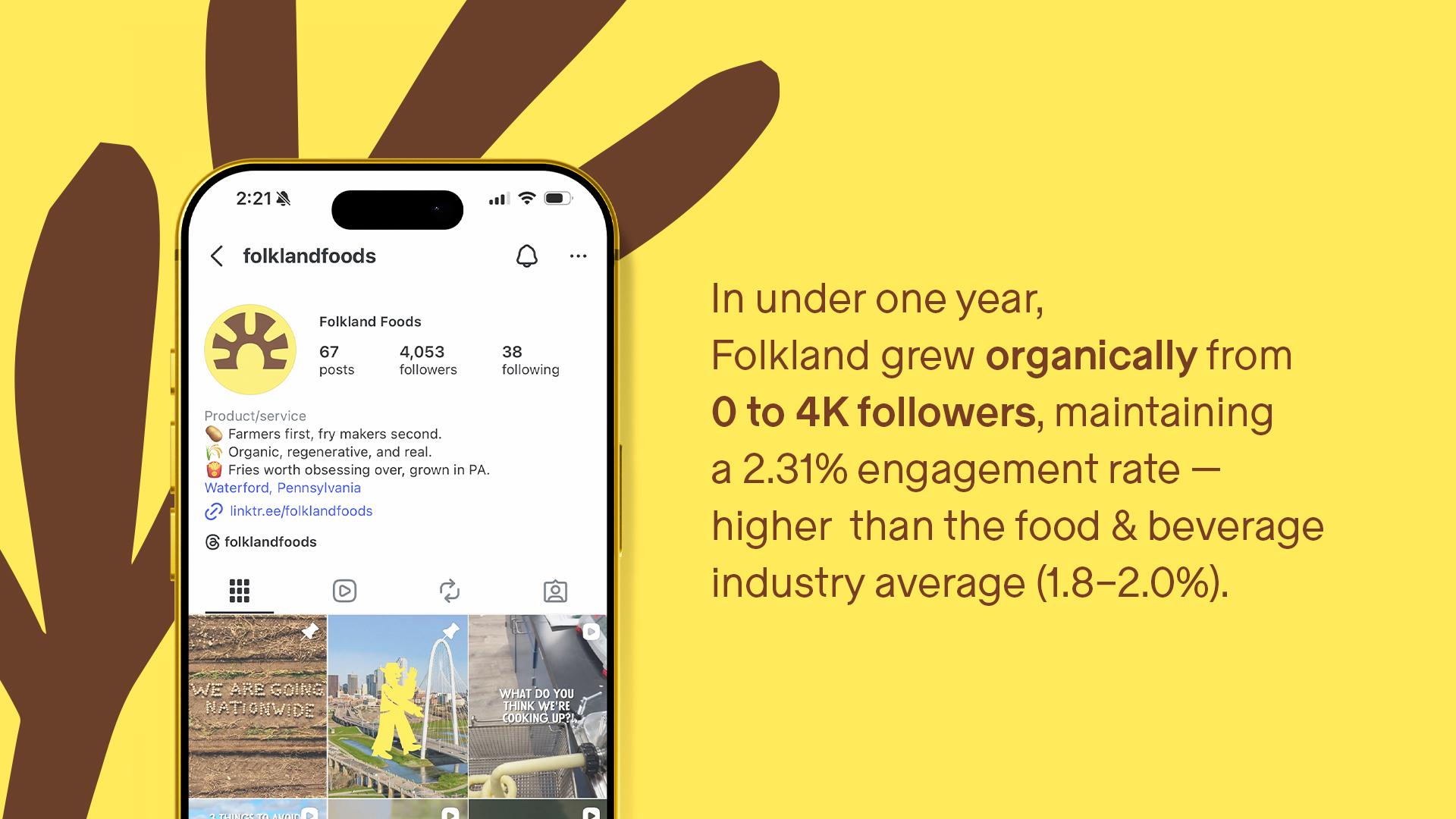
Folkland is a better-for-you sparkling botanical beverage brand that went from zero social media presence to a national rollout in over 1,000 stores between 2024 and 2026. When they first came to MAVRK Studio, they had a nearly finished product and a tight retail timeline-but no followers, no content library, no launch content, and no community.
We built everything from scratch: brand identity, packaging, photography, ecommerce, and a full social media marketing strategy, all running in parallel rather than in sequence. The launch milestones moved fast. Month one focused on content library creation and a soft digital launch across Instagram and TikTok. Month two introduced paid social tests and retailer announcement content. By month three, Folkland was supporting national expansion with community-driven campaigns and UGC initiatives.
The results were tangible. Folkland grew from zero to a 10,000+ engaged Instagram community. Consistent user-generated content started flowing in without paid incentives. Sell-through improved noticeably in weeks four through eight post-launch as social awareness caught up with shelf placement. Data-driven results ensured that marketing campaigns were based on measurable progress, not guesswork.
A full Folkland deep dive appears later in this article. But this early snapshot exists to prove a point: a social media manager agency that understands F&B can build a community from nothing, on a clock, and tie it directly to retail performance.
What a Social Media Manager Agency Does for F&B & CPG Brands
The term “social media manager agency” can mean wildly different things depending on who you ask. For packaged food, beverage, and restaurant launches, it needs to mean something specific.
At its core, the work includes channel strategy (which platforms, what cadence, what content format), content planning mapped to real-world launch milestones, daily publishing and optimization, community management, influencer coordination, paid advertising setup and management, and ongoing reporting tied to commercial outcomes. A social media management agency manages a brand’s online presence across platforms-but for CPG, every one of those platforms has to connect back to what’s happening in stores, in distributor warehouses, and on ecommerce product pages.
Agencies produce multimedia assets like graphics, videos, and copywriting for social media. A top agency has a team of experts for diverse tasks: strategists who understand retail calendars, designers who know what works in a 9:16 Reel, community managers who can handle a flood of “where can I buy this?” comments, and paid media specialists who can geo-target ads to store clusters getting their first shipment.
Professional agencies develop content calendars aligned with business goals and target demographics. Agencies typically manage content calendars for consistent posting. But in F&B, that calendar can’t exist in a vacuum-it has to reflect co-packer timelines, packaging finalization dates, promo windows, distributor pushes, and retailer reset schedules. Agencies optimize posting times across social channels to maximize reach and engagement, but the timing also needs to sync with when product actually hits shelf.
More than 70% of CPG purchase decisions are now influenced by social media content before a consumer walks into a store. Social media management agencies can integrate marketing efforts to create cohesive brand messaging-but only if they understand the CPG world well enough to know what “cohesive” actually means in the context of a shelf reset, a broker meeting, or a distributor presentation.
MAVRK Studio integrates social media into a 90-day launch system, rather than bolting it on after packaging or sales are already locked in, reflecting our broader role as a food and beverage marketing agency.
Why Generic Social Media Marketing Agencies Fall Short for CPG Launches
Most social media marketing agencies serve diverse industries. They work across various industries-SaaS, fashion, fitness, real estate, other sectors-and apply a broadly similar playbook to each. That playbook works for many clients, but it breaks down when applied to food and beverage launches.
Here’s why: a generic digital marketing agency doesn’t understand slotting fees, scan data, velocity targets, promo calendars, or how retail brokers and distributors actually work. They might create beautiful content that gets engagement, but if that content doesn’t reflect planogram constraints, shelf-pack configurations, or flavor availability in specific regions, it confuses both consumers and buyers. Content from a non-CPG marketing agency often misses key realities like DSD limitations, supply constraints, or the difference between a junior shelf placement and an end-cap.
Choosing a social media agency involves evaluating their industry experience and portfolio metrics. Volume across diverse industries isn’t the same as depth within one. Choose agencies based on their understanding of your industry. Effective social media strategies require familiarity with platform-specific algorithms and trends, yes-but for CPG, they also require familiarity with how a buyer at Sprouts thinks differently than a buyer at Walmart.
F&B brands don’t just need more leads in the generic sense. They need specific types of demand:
- Retailer pull (buyers seeing consumer interest and committing to reorders)
- DTC subscribers (direct revenue and data)
- Wholesale and distributor inquiries
- Broker interest from seeing a brand with momentum
Each of these requires a tailored social media strategy. Even smaller agencies that specialize in food and beverage will outperform larger, horizontal agencies that treat your sparkling water the same way they treat a SaaS product.
When evaluating a social media marketing company for your launch, look for partners that talk in retail metrics-velocity, scan data, distributor coverage, reorder rates-as comfortably as they discuss engagement rates and ROAS, and consider shortlisting from top CPG branding agencies in the U.S..
Integrated Launch vs. Fragmented Vendors: MAVRK’s Approach
Here’s the typical “fragmented launch” pattern we see when brands come to us: one firm for branding, another for packaging design, a freelancer for photography, a web developer for ecommerce, and a separate social media marketing company to handle posting. Each vendor works in isolation, on different timelines, with different creative directions.
The problems this creates on social media are predictable and painful:
- Visual identity doesn’t match across packaging, website, and social posts
- Messaging is disjointed because the social team wasn’t in the positioning conversations
- Content launches late because the photographer delivered assets after the social calendar was supposed to start
- Packaging that actually ships doesn’t match what was shown in early social content, confusing customers
Hiring a social media management agency can drive community engagement and align with business objectives-but only if the agency is connected to the rest of the launch. Successful social media management requires a clear strategy that aligns with broader marketing goals, and those goals should include packaging, shelf presence, and ecommerce, not just follower counts.
MAVRK Studio’s integrated model eliminates these gaps. One team handles category validation, positioning, brand identity, packaging, ecommerce, photography, launch content, and social media marketing services. That means the social media manager function can plan content before packaging is final, align story arcs with retail launch dates, and pre-build content libraries during the same shoots that produce ecommerce assets and sell-sheet imagery.
For example: when we’re finalizing packaging for a new snack brand, our photographer is simultaneously shooting vertical video for TikTok, lifestyle stills for Instagram, and product-on-white images for Amazon. The social team is in the room, planning which assets become launch-week Reels, which become paid ad creative, and which become evergreen UGC prompts. Nothing is built twice. Nothing is misaligned.
Understanding Your Target Audience for F&B Social Media
In 2026, food and beverage brands face crowded shelves and algorithmic feeds simultaneously. Target audience definition isn’t a theoretical exercise-it determines whether your content gets seen, saved, and acted on, or whether it disappears into a feed that’s already saturated with recipe videos and taste-test clips.
MAVRK profiles a target audience for CPG across three dimensions:
- Demographics: age, income, household size, geography
- Psychographics: values like sustainability, indulgence, health-consciousness, convenience
- Shopping behaviors: Instacart versus in-store, club store versus natural channel, Amazon versus brand DTC
These segments look different for different products. Health-conscious Millennials shopping at Whole Foods respond to ingredient sourcing content and clean-label claims. Gen Z discovering drinks on TikTok wants trend-native content, bold flavors, and creator endorsements. Parents buying snacks at Target care about convenience, price-per-serving, and kid-approved taste. Each group has distinct social behaviors that change how you create content, which social channels you prioritize, and what messaging you lead with.
Target audience clarity feeds directly into both organic social media marketing and paid social audience targeting. If you know your target market is 28- to 40-year-old women in the Southeast who shop Publix and care about gut health, you can build lookalike audiences, geo-target paid ads to Publix locations, and create content that speaks their language. Social media marketing agencies optimize brand presence across multiple platforms, but optimization without audience precision is just noise.
This audience work also shapes your brand voice. A sparkling water for nightlife-adjacent occasions sounds different from a protein shake for CrossFit athletes. Your social media manager agency needs to nail that voice before the first post goes live.
From Category Validation to Launch Story: Social Strategy in the 90-Day System
Most brands treat social media as something that starts after the product is finished. That’s backwards. At MAVRK, our validate-first methodology means social media narrative work begins during category validation and positioning-before a single post is published.
Here’s how it works: during the validation phase, we research the competitive landscape, identify white-space positioning, and test messaging concepts. That research directly shapes the social media strategy. If validation reveals that “low-sugar hydration for night-shift workers” resonates more strongly than “family-friendly wellness drink,” the entire content approach changes-what we film, what claims we spotlight, what creators we partner with, and which retailers we tag.
The 90-day launch system breaks into phases, and each one has specific social media marketing actions:
Days 1–30 (Validate & Build):
- Finalize positioning and messaging pillars
- Begin content library production during packaging and photo shoots
- Launch polls and early taste-test feedback clips to validate demand
- Seed “help us choose a flavor” interactive content on Instagram Stories
Days 31–60 (Launch & Amplify):
- Publish launch-week content: retailer announcements, shelf photos, store-locator posts
- Activate paid social campaigns geo-targeted to first retail authorizations
- Initiate influencer marketing campaigns and UGC seeding
- Begin community management at scale
Days 61–90 (Optimize & Scale):
- Analyze campaign performance and refine content mix
- Scale paid social to new markets as distribution expands
- Drive engagement through recipe content, customer reaction clips, and retailer features
- Compile reporting for buyer meetings and investor updates
Agencies analyze performance data to refine marketing strategies throughout this process. Analytics and reporting track performance metrics like engagement and conversions to inform strategy at every phase. The result is a social media launch plan built on research, not personal taste-and increasingly shaped by AI in F&B social media marketing.
Channel Selection: Choosing the Right Social Platforms for Food & Beverage
Not every social media platform deserves your time and budget. The right mix depends on your target audience, price point, retail strategy, and the creative assets you have available.
Here’s how we think about platform selection for F&B brands:
| Platform | Best For | Example Use Case |
|---|---|---|
| Instagram (Reels, Stories, Feed) | Brand storytelling, retail updates, lifestyle content | Refrigerated snack brand posting weekly recipe Reels |
| TikTok | Discovery, virality, trend-driven awareness | Sparkling beverage leveraging “FoodTok” taste-test trends |
| Local store callouts, older demographics, community groups | Regional sauce brand targeting 40+ home cooks | |
| Recipe search, long-tail discovery, meal planning | Specialty pantry staple with recipe carousels | |
| B2B buyers, investor comms, broker/distributor visibility | Founder sharing retail expansion milestones | |
| A refrigerated snack brand might focus heavily on Instagram Reels and TikTok, where visual food content thrives and Gen Z and Millennial shoppers discover new products. A specialty pantry staple-say an artisan olive oil-might invest more in Pinterest recipe pins and Instagram carousels, where the audience is searching with purchase intent rather than scrolling passively, supported by broader food and beverage marketing strategies that drive growth. |
Agencies help brands stay updated on social media trends and competitor movements, but the real value is in choosing where to compete. If you can only commit to one or two platforms at first, start where your audience already lives and where you have the strongest creative assets.
A social media marketing agency specializing in F&B tailors both platform mix and posting cadence based on launch phase. During validation, you might experiment on three platforms to test content styles. During launch, you concentrate ad spend and energy on the top one or two that showed the strongest response. After launch, you scale cadence and renew creative.
Content Creation for CPG: What to Post Before and After You Hit Shelves
There’s a content arc that every social media manager agency should plan around a launch: pre-launch, launch week, and first 90 days in-market. Each phase has different objectives and calls for different types of content.
Pre-launch content builds anticipation and establishes the brand before product is available:
- Behind-the-scenes production footage (co-packer visits, ingredient sourcing)
- Founder story and brand origin
- Packaging reveals and flavor teasers
- Polls and interactive content (“Which flavor drops first?”)
- Retailer announcement teasers
Launch-week content converts awareness into action:
- Store-locator posts with geo-tagged retail partners
- Shelf photos showing the product in its natural habitat
- Promo callouts (launch discounts, sampling events)
- Influencer unboxing and first-taste reactions
Post-launch content sustains momentum and builds community:
- Simple recipe content (e.g., “3-ingredient mocktail using the product”)
- Customer reaction clips and tagged UGC
- Usage occasion content (morning routine, post-workout, hosting)
- FAQ responses (“Is this gluten free?” “Where can I find this near me?”)
- Restocking and sold-out indicators to create urgency
The foundation of all of this is a pre-shot content library. At MAVRK, we create content during brand and packaging shoots-photography, vertical video, GIFs, and UGC prompts-so that there’s no scramble once launch week arrives. Agencies should explain their methodology and show performance data, but the best agencies also show you a library of ready assets before the first post goes live.
Quality content is what separates brands that build organic traffic and sustained engagement from brands that post for a week and go quiet.
Building and Managing Community: Turning Followers into Fans
Community management is more than replying with heart-eye emojis. It’s daily relationship-building that signals brand reliability to both customers and retail buyers. Community management involves monitoring interactions and responding to customer inquiries online. Community management is essential for building trust and maintaining a positive brand image online.
Here’s what a social media manager agency should be doing every day for an F&B brand:
- Replying to every comment within hours, not days
- Resharing UGC (customer photos, tagged stories, reviews)
- Answering product questions in comments and DMs (“Which Whole Foods locations carry this?” followed by a store link)
- Acknowledging retailers that post about stocking the product
- Using story highlights to create a living FAQ (ingredients, allergens, store finder)
- Practicing social listening to catch untagged brand mentions and emerging conversations
Social media management can increase engagement by 132%. That’s not a hypothetical-engagement rates can increase by 132% after implementing effective strategies that prioritize genuine interaction over broadcast-style posting.
Strong community interaction directly drives commercial outcomes. More tagged shelf photos mean more social proof for buyers evaluating a reset. Higher review volume on retail sites correlates with better placement. Consistent interaction builds the kind of customer base that shows up when a product hits a new market.
At MAVRK, we coach brands on tone-of-voice guidelines so community responses feel human and on-brand. We define how the brand should respond to praise, complaints, ingredient questions, and “where to buy” inquiries-ensuring the brand voice stays consistent whether the founder or a team member is handling the account.
Paid Social for Launches: Turning Social into a Growth Engine
Relying solely on organic social media is risky when you’re working against a retail clock. You might produce exceptional content, but organic reach on most social channels hovers in the single digits as a percentage of your followers. Paid social and paid advertising let you reach the right people, in the right geography, at the right time.
For CPG launches, paid social objectives typically fall into three categories:
- Driving first-time trial via store-locator clicks, coupon downloads, or sample sign-ups
- Building retailer-specific awareness around new authorizations (targeting consumers near newly stocked stores)
- Seeding early DTC or subscription revenue through direct-response campaigns
The platforms that matter most for F&B paid social in 2026 are Meta (Facebook and Instagram), TikTok Ads, and occasionally Pinterest Ads for recipe-focused brands. Paid advertising services include creating and managing social media ad campaigns, but the execution needs to be tied to retail geography and launch timing.
The numbers support the investment. Thrive increased online leads by 148% for their clients. Ignite Social Media clients see a 57% increase in impressions. Thrive generated 668,120 social media reach for a therapy center. Faceplant reduced CPC from $4.48 to $1.21 for a client through campaign optimization. Social media marketing agencies help lower cost per acquisition, and agencies can help reduce cost per acquisition by optimizing campaigns with better creative, tighter targeting, and smarter bidding.
Businesses benefit from agencies’ ability to run targeted ad campaigns for improved reach. At MAVRK, we set up full-funnel campaigns-awareness, consideration, conversion-with tracking links to measure lift in website traffic, coupon downloads, website clicks, and sample sign-ups. Media buying is handled in-house, which means ad campaigns and creative are developed by the same team, not passed between vendors.
The key is using paid social to accelerate what organic is already signaling. If a particular Reel is getting strong saves and shares organically, that’s a signal to put ad spend behind it and push it to new audiences via lookalike targeting.
From Impressions to Qualified Leads: Social Media’s Role in CPG Sales Pipelines
For F&B and CPG, qualified leads can mean very different things depending on the context:
- Retailer category buyers interested in stocking the product
- Foodservice operators (restaurants, hotels, cafeterias) looking for suppliers
- Distributors and brokers discovering brands with momentum
- Investors who see community traction and want in
- High-value DTC subscribers who become repeat purchasers
A social media manager agency can help generate each of these lead types, but the strategy for each is different. A LinkedIn post about a successful 200-store launch might attract broker inquiries. An Instagram ad driving store-locator clicks might generate DTC sign-ups for a region where retail distribution hasn’t arrived yet. A well-crafted TikTok going semi-viral might catch the eye of a regional buyer scrolling during lunch.
Lead generation for CPG works best when content and lead magnets are tailored:
- Sell sheets and line cards downloadable from a simple landing page
- Digital tastings or sample boxes gated behind a lead form
- Investor one-pagers linked from founder LinkedIn content
- Retailer-specific landing pages tied to social ad campaigns
Ongoing performance reporting from agencies allows for tracking metrics like engagement and ROI, connecting awareness-level metrics to commercial conversations. Agency collaboration provides access to specialized expertise in social media marketing that most in-house teams can’t replicate, especially during a time-compressed launch.
MAVRK builds landing pages and lead-capture assets that tie seamlessly to social campaigns, creating a clear bridge from increased brand awareness to real commercial conversations. The goal is to effectively reach the right people-not just accumulate impressions-and convert awareness into the kind of pipeline that supports retail expansion.
Metrics That Matter: How We Measure Social Media Success for F&B
Too many food brands fixate on follower counts and call it progress. Follower counts are nice, but they don’t tell a buyer whether your product will move on shelf. A social media manager agency that understands CPG focuses on metrics that correlate with commercial outcomes.
Here are the core social media marketing metrics MAVRK tracks:
| Metric | Why It Matters for CPG |
|---|---|
| Engagement rate | Measures genuine interest, not just eyeballs |
| Saves and shares | Indicates purchase intent and content value |
| Story completion rate | Shows audience attention and message retention |
| Click-through rate (CTR) | Connects content to action (store locator, DTC) |
| Cost per click (CPC) | Measures paid efficiency for launch campaigns |
| ROAS | Ties ad spend directly to revenue |
| Store-locator clicks | Links social to in-store foot traffic |
| UGC volume | Proves organic community activity for buyers |
| The magic is in connecting social metrics to commercial outcomes. Store-locator clicks should correlate with in-store velocity. Email sign-ups should connect to DTC revenue. Retail mentions in stories should precede reset success. Email marketing services can yield an average ROI of $36 per dollar spent, and when email is integrated with social campaigns, the combined effect is even stronger. |
Here’s a concrete example: a brand posting recipe content that generates a 30% increase in save rate over four weeks might also see a 10–15% lift in repeat purchases over 60 days. That’s the kind of data that matters to a Kroger buyer, not just how many people liked a photo.
Reporting should be an ongoing conversation between the social media manager agency, the founder, and the sales team-not just a monthly PDF that no one reads.
At MAVRK, campaign performance data feeds directly into retail pitch materials, investor updates, and distributor conversations. Every metric has a purpose beyond the dashboard.
Working with MAVRK Studio as Your Social Media Manager Agency
When an F&B brand hires MAVRK Studio to manage social as part of a launch, the experience is different from working with a standalone social media agency. Social media isn’t a separate department or an afterthought-it’s embedded in the same team and system that’s building your brand, packaging, ecommerce, and retail materials.
The key roles on the MAVRK team include:
- Strategist: oversees positioning, content strategy, and alignment with retail timelines
- Social media manager: handles daily publishing, scheduling, and platform management
- Copywriter: develops captions, ad copy, and brand messaging
- Designer: creates social templates, graphics, and visual assets
- Photographer/videographer: produces content for social, ecommerce, and sales materials simultaneously
- Paid media specialist: manages ad campaigns, media buying, and performance optimization
- Account manager: serves as the single point of contact, coordinating between the brand and the team
Communication follows a predictable cadence: weekly check-ins, shared content calendars, and monthly reporting aligned to production and retail timelines. Client feedback flows directly into content adjustments rather than disappearing into a ticketing system.
Cost-effectiveness comes from outsourcing social media management instead of building an in-house team. Outsourcing to a social media agency saves time for business owners and internal teams, letting founders focus on product, sales, and operations while the agency handles the daily execution. Every brand gets exceptional service without needing to hire five separate roles internally.
MAVRK also collaborates closely with co-packers, brokers, and distributors so that social campaigns support real-world execution. When a distributor push is happening in the Southeast, the social team knows about it and adjusts content, geo-targeting, and store-locator posts accordingly.
Step-by-Step: MAVRK’s 90-Day Social Media Launch Framework
Here’s how the 90-day system works for social media, broken into three practical phases. Scalable agency services provide flexibility to adapt to business growth or seasonal changes, and this framework is designed to flex with your specific business timeline.
Days 1–30: Validate & Build
This phase is about research, asset creation, and foundation-setting.
- Finalize target audience profiles and content strategy based on category validation
- Audit competitive social landscape (what’s working for similar brands, what’s not)
- Produce content library during brand and packaging photo/video shoots
- Build social profiles, create visual templates, and establish brand voice guidelines
- Develop the content calendar for the full 90-day arc
- Set up tracking infrastructure (UTM links, pixel installation, store-locator integration)
Example for a hypothetical beverage launch: Week 1–2, the team shoots 150+ assets during the packaging photoshoot. Week 3, social profiles go live with “coming soon” content and founder story posts. Week 4, behind-the-scenes production content and flavor-reveal polls drop on Instagram Stories and TikTok.
Days 31–60: Launch & Amplify
This is where the product hits shelves and social media shifts from anticipation to action.
- Publish launch-week content: shelf photos, store-locator posts, retailer shout-outs
- Activate paid social campaigns targeting consumers near first retail placements
- Seed influencer marketing campaigns with micro-creators in key markets
- Create content and reshare early UGC from customers who find the product
- Monitor community daily, responding to comments and DMs in real time
- Begin A/B testing ad creative, audiences, and placements
Example: Day 35, a TikTok creator posts an unboxing of the new beverage. The MAVRK team boosts it as a Spark Ad, achieving a CPM of $4–$6 and driving a measurable spike in store-locator clicks. Day 45, a customer tags the brand in a grocery haul video-that UGC gets reshared and becomes one of the highest-performing organic posts of the month.
Days 61–90: Optimize & Scale
Now the focus shifts to refining what’s working and expanding reach as distribution grows.
- Analyze 60 days of data: which content types drive the most saves, shares, and clicks?
- Scale paid social budget to new markets and retailers
- Refresh creative assets to prevent fatigue
- Develop recipe and usage-occasion content for sustained engagement
- Compile performance reports for retail buyer meetings and investor updates
- Plan the next 90-day content arc based on what the data shows
This framework aligns social media milestones directly with operations: first production run, first retail shipments, first resets, and early reorder windows. Nothing is arbitrary.
Folkland Deep Dive: Building an Online Community from Zero
Folkland is the proof that a social media manager agency can build an entire community from nothing and connect it directly to in-store results. Here’s the full story.
Folkland is a sparkling botanical beverage brand positioned in the better-for-you category-low sugar, clean ingredients, vibrant packaging. When they engaged MAVRK Studio in 2024, they had a nearly finished product, a production partner, and a retail timeline that required fast execution. What they didn’t have was a single social media follower, a content library, a website, or any of the digital infrastructure modern retail buyers expect.
The Integrated Approach
Rather than handing social media to one vendor and packaging to another, MAVRK developed Folkland’s brand identity, packaging design, initial photography, ecommerce site, and social media marketing strategy together-as a single, unified project. This meant the social team was involved from the first positioning conversation through final packaging approval. Every asset was shot for dual use: product photography for the website and sell sheets, vertical video for TikTok and Reels, lifestyle imagery for Instagram feed posts.
The Timeline
Month 1: Content library creation and soft launch. MAVRK shot over 200 assets during a two-day production session. Instagram and TikTok profiles went live with founder story content, ingredient sourcing behind-the-scenes footage, and flavor-reveal interactive posts. Early engagement was modest but genuine-real comments, real questions, real saves.
Month 2: Paid social tests and retail announcement content. MAVRK launched geo-targeted ad campaigns on Meta and TikTok tied to Folkland’s first 250 retail doors. Store-locator posts went up weekly as new locations stocked the product. Influencer marketing campaigns with micro-creators in key markets generated UGC at scale.
Month 3: National expansion support and community-driven campaigns. As Folkland scaled past 500 doors toward 1,000+, the social strategy scaled with it. Customer-generated content started flowing in without paid incentives. Engagement rates consistently exceeded category benchmarks. Retailers who initially took small test orders began requesting expanded facings after seeing online buzz.
The Outcomes
From zero to over 10,000 engaged Instagram followers. A consistent stream of UGC-customers posting shelf finds, taste tests, recipe creations-that provided perpetual social proof. Sell-through improvements in weeks four through eight post-launch as social awareness translated into consumer demand. Fewer stagnant stores. Stronger support from brokers and distributors who were impressed by the digital presence.
Most critically, Folkland’s online community became a sales tool. When the team walked into buyer meetings, they could show engagement data, comment sentiment, UGC volume, and store-locator click rates alongside their sell sheets and margin projections. That combination changed the conversation.
Aligning Social Media with Packaging, Shelf, and Ecommerce
For CPG, social content must visually and verbally match what shoppers see on shelf, on Amazon, and on the brand’s own ecommerce site. If a customer discovers a product through a TikTok ad and then encounters different colors, different claims, or a different name in-store, trust breaks. Conversion drops.
MAVRK ensures consistency by using the same brand identity system across every touchpoint. Hero claims like “2g sugar” or “plant-powered hydration” appear the same way on packaging, in social posts, on product pages, and in sell sheets. Flavor names, color codes, typography, and photography style are locked in before any content goes live.
Concrete examples of what this looks like in practice:
- The packaging hero shot used on the front panel is the same composition used in Instagram feed posts and Amazon listing images
- Color palettes from the packaging design system are applied to social templates, story graphics, and paid ad creative
- Claims verified for packaging compliance are the same claims used in ad copy-no exaggeration, no disconnection
- Retail sales materials (sell sheets, shelf talkers) use the same visual language as social content
This alignment reduces confusion, improves ad performance (because what consumers see in an ad matches what they find in-store), and helps first-time buyers recognize the product quickly in crowded aisles.
At MAVRK, photographers and videographers shoot both ecommerce and social assets in the same sessions. That’s not a cost-cutting shortcut-it’s a deliberate strategy to guarantee visual continuity across every customer touchpoint.
Social Media for Restaurant Brand Launches
Restaurant launches and relaunches share DNA with CPG launches but have distinct digital marketing needs. The timeline is compressed (often anchored to a fixed opening date), the target audience is hyper-local, and the social content has to drive physical visits rather than add-to-cart clicks.
MAVRK adapts its social media manager process for restaurants by focusing on the same pillars that underpin effective social media strategies for restaurants:
- Soft-opening promotion: Behind-the-scenes prep content, chef features, kitchen walkthroughs timed to build anticipation before doors open
- Reservation and booking links: Integrated into every bio, story, and post to convert interest into seated diners
- Menu reveals: Strategic rollout of menu items (one dish per day, for example) to sustain interest across the launch week
- Local partnerships: Cross-promotion with neighborhood businesses, food writers, and local influencers
Key social channels for restaurants are Instagram (for visual storytelling), TikTok (for viral food content), and Google Business Profile integration (for local search visibility and reviews). Local paid social-geo-targeting within a 5- to 15-mile radius-is critical for driving first-week bookings, and partnering with the best marketing agency for restaurants can help orchestrate this mix effectively.
For restaurants, early reviews and UGC are equivalent to qualified leads. A strong first week of tagged Instagram stories and positive Google reviews shapes perception among local diners and hospitality media. That early momentum is what restaurant branding agencies should be building toward from day one.
Funding, Investors, and Social Proof: Why Your Cap Table Cares About Social
By 2026, F&B investors and funds routinely review a brand’s social presence alongside pitch decks and financials. This isn’t vanity-it’s due diligence. An investor evaluating a seed-stage beverage brand wants to see evidence that the team can build a community, communicate a clear positioning, and execute a modern go-to-market strategy.
What investors look for on social:
- Clear, consistent positioning that matches the pitch deck narrative
- A responding community (not just followers, but comments, questions, UGC)
- Visible traction that grows over time (not a spike from one paid campaign)
- Evidence that the team understands digital marketing and can execute, not just talk about it
Strong social media presence often leads to better fundraising terms. When an investor sees a brand with 10,000 engaged followers, consistent UGC, and clear demand signals, they’re more confident in the valuation and more willing to write a check. They’re not investing in a social media account-they’re investing in proof that the brand can create demand.
MAVRK helps founders prepare for this by building credible founder-facing content on LinkedIn, ensuring brand profiles are clean and active, and compiling data snapshots showing social-driven growth. We also produce materials like pitch decks and investor one-pagers that incorporate social proof as a core element.
Social is a commercial asset that de-risks investment. Treat it that way.
Budgeting for Social Media Management in a CPG Launch
One of the most common mistakes funded founders make is allocating for production, trade spend, and broker fees-and then treating social media as whatever’s left over. That math doesn’t work in 2026.
Here’s how to think about budgeting for social media marketing services within an overall launch:
Industry benchmarks: Social media management costs range from $650 to $1,000 monthly for basic services, and social media management services start at $600 per month for entry-level packages. Hourly rates for social media marketing agencies cluster between $25 and $49. Most social media marketing projects fall under $10,000, and most social media marketing projects cost under $10,000 for individual campaign scopes. Agencies typically charge between $25 and $49 per hour for execution work.
Keep in mind that agency fees are separate from ad spend and creation costs. Your monthly management fee covers strategy, calendar management, community management, and reporting. Your ad spend is a separate line item that goes directly to the platforms. And if you need additional creative production (photoshoots, video shoots), that’s a third category.
Typical allocation for a funded CPG launch:
| Budget Category | Approximate Share |
|---|---|
| Organic social management | 15–20% of marketing budget |
| Paid social ad spend | 20–30% of marketing budget |
| Creative production (photo, video) | 15–25% of marketing budget |
| Remaining (trade, PR, events) | 30–40% of marketing budget |
| Common missteps to avoid: |
- Underfunding social in the first 90 days when awareness matters most
- Spending heavily on paid advertising without allocating for creative refreshes (ad fatigue is real)
- Skipping community management to save money, then wondering why engagement drops
- Assuming competitive pricing means cheap-the best agencies aren’t the cheapest, but they deliver returns
77.6% of small businesses use social media for promotion. The question isn’t whether to invest-it’s how to invest wisely. A strategic partner like MAVRK helps you allocate budget where it will drive the most impact for your specific business and marketing needs, not just spread money evenly across every platform.
Free Proposal and Next Steps: How to Evaluate a Social Media Manager Agency
If you’re preparing to launch or relaunch a food, beverage, or CPG product, the best next step is to request a free proposal from MAVRK Studio. Our proposals cover social media marketing, launch content, and broader 90-day launch planning tailored to your specific product, timeline, and retail strategy.
But whether you choose MAVRK or another partner, here’s what a strong proposal from any social media marketing agency should include:
- A clear understanding of your category and competitive landscape
- A defined target audience based on research, not assumptions
- A sample content direction with visual references and messaging pillars
- Realistic KPIs tied to your business goals, not just vanity metrics
- A timeline that aligns social media milestones with your production and retail schedule
Questions to Ask Any Agency You’re Evaluating
- “How have you aligned social campaigns with retailer reset calendars?”
- “What have you launched in food and beverage since 2022? Show me the track record.”
- “How do you tie social metrics to retail velocity and sell-through data?”
- “Do you have digital marketing experts who understand CPG distribution, or will I need to educate your team?”
The best agencies don’t just have a proven track record across many clients-they have depth in your category. They should function as a strategic partner, not a content vending machine. They should understand your marketing goals, your retail timeline, and the commercial outcomes that matter to your business.
Here’s how MAVRK’s proposal process works: we start with a discovery call to understand your product, timeline, and distribution plan. We review current assets-packaging, photography, existing social content (if any). Then we deliver a tailored plan that integrates social media with the full launch system, from validation through retail readiness.
The brands winning shelf space and consumer loyalty in 2026 are the ones treating social media as a core launch channel, not an afterthought. MAVRK Studio is built to make that happen.
If Folkland’s story proves anything, it’s this: community isn’t built after a launch. It’s what makes the launch work. Request your free proposal today or contact MAVRK Studio and let’s build yours.