



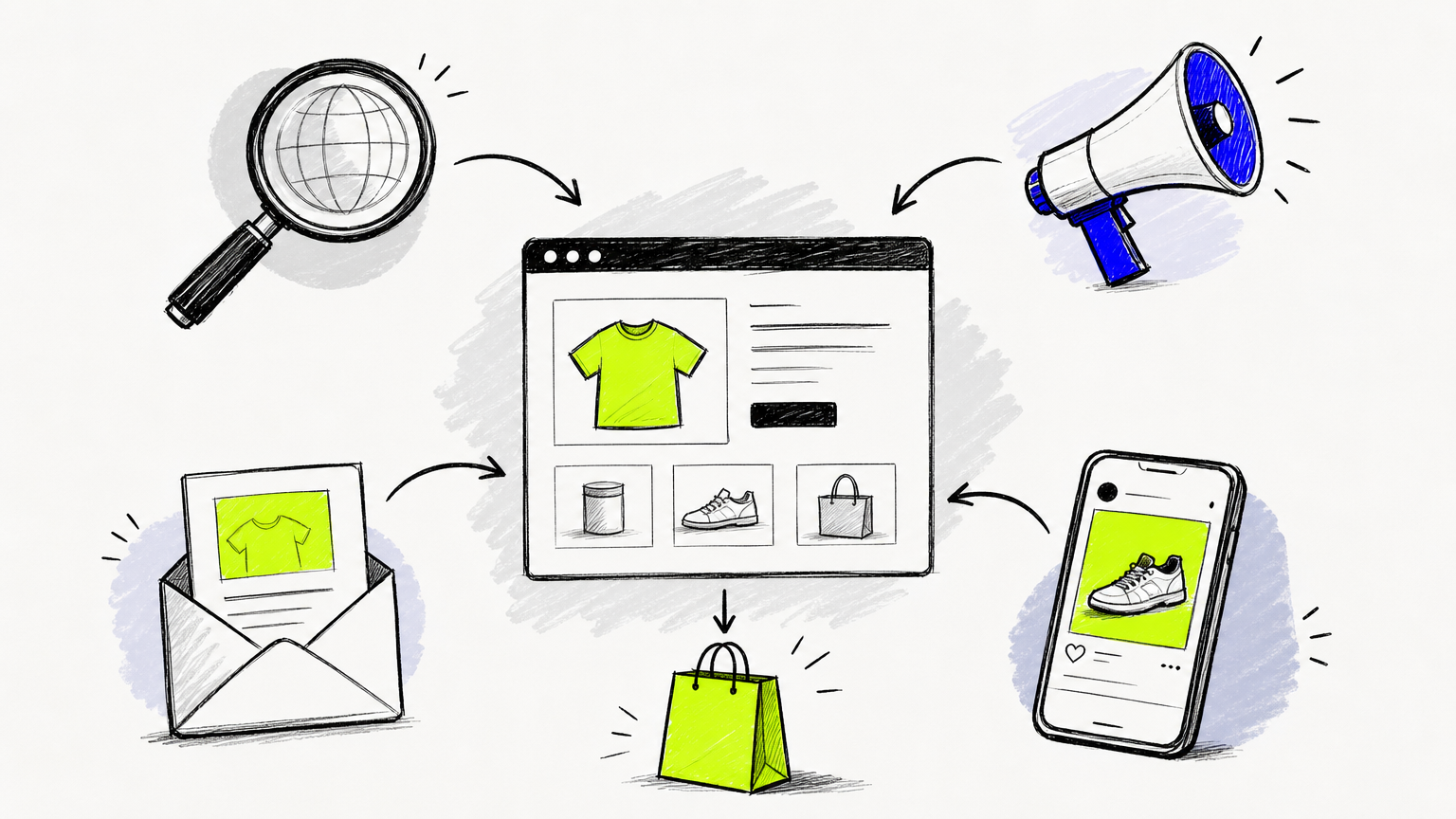
An ecommerce digital marketing agency is a specialist firm that helps online retailers grow revenue through channels like SEO, paid search, social advertising, email, and conversion rate optimization. Unlike generalist shops, these firms live inside the mechanics of online retail. MAVRK Studio works with ecommerce brands to build strategies grounded in buyer intent, traffic quality, and measurable return on ad spend, not vanity metrics dressed up in a deck.
What Is an Ecommerce Digital Marketing Agency
Core definition and scope
An ecommerce digital marketing agency focuses on online retailers, D2C brands, and marketplace sellers rather than serving every business type with the same playbook. Core services typically include SEO, paid media (Google Shopping, PPC), social advertising, email and SMS marketing, and conversion rate optimization. The through-line is product-based revenue, which shapes every recommendation. A good partner treats brand strategy and marketing strategy as separate but linked disciplines.
How it differs from a generalist agency
Specialist agencies build expertise inside Shopify, WooCommerce, and Magento. They understand product page architecture, category structure, and checkout funnel behavior at a level a generalist rarely reaches. Generalists spread resources across industries. Specialists develop repeatable playbooks tuned to product-based revenue. That distinction matters at scale: a specialist reads ROAS, AOV, and CAC like a native language, similar to how a strong CPG branding strategy reads shelf behavior.
Takeaway: if the pitch deck could belong to a law firm, a SaaS, and a shoe brand without edits, you are looking at a generalist.
Core Services Ecommerce Agencies Provide

Search marketing: SEO and paid search
Ecommerce SEO covers product page optimization, category architecture, technical site health, and content strategy pointed at buyer-ready keywords, not top-of-funnel filler. Google Shopping and Performance Max campaigns focus on maximizing ROAS while controlling CAC, the two numbers that decide whether growth is real. Paid search sits next to SEO, not against it. Together they compound. For consumer brands, this often connects back to cost-effective marketing strategies that respect a real budget.
Social and display advertising
Meta and TikTok drive top-of-funnel awareness and retargeting for cart abandonment. Those are two distinct objectives with two distinct creative strategies, and mixing them is a common way to burn budget. Prospecting creative sells the promise. Retargeting creative removes friction. TikTok Shop has added a commerce layer that is worth its own approach, covered in TikTok Shop for CPG brands.
Email, SMS, and retention marketing
Email and SMS retention programs target repeat purchase rate and lifetime value, the metrics that decide whether a D2C brand is profitable at all. First-order margins are often negative once you count acquisition. Retention flips the math. Welcome series, browse abandonment, post-purchase, winback, replenishment: these are the workhorses. Retention lives closer to brand identity in hospitality and consumer brands than most founders expect.
AI search and generative engine optimization
Generative engine optimization (GEO) and answer engine optimization (AEO) are the newest additions to the stack. They help brands show up in ChatGPT, Perplexity, and Google’s AI Overviews. Most brands have not addressed this channel yet, which is exactly why it is worth addressing now. The tactics overlap with classic SEO but reward structured content, clear entity signals, and citations. Think of it as an extension of creativity in marketing for CPG brands, applied to machine readers.
Takeaway: the strongest agencies run SEO, paid, social, retention, and AI search as one system, not five silos.
How Ecommerce Agencies Differ From In-House Teams

Expertise breadth vs. depth
An in-house marketer typically covers multiple channels at a surface level. An agency brings channel specialists, SEO, paid, creative, analytics, under one engagement. Agencies also hold platform certifications, access to beta features, and cross-client pattern recognition that a single in-house hire rarely accumulates. That pattern library is the quiet advantage. A partner that has seen fifty product launches thinks differently about your next one, the same way a seasoned brand builder vs. product pusher reads a category.
Cost and resource considerations
The agency model converts a fixed headcount cost into a variable service cost that scales with seasonal demand, a structural advantage for retail. In-house teams still win on brand depth and speed of decision. Agencies counter with benchmarking data pulled from managing multiple ecommerce accounts. Many mid-market brands in the $1M to $15M range end up hybrid: a small internal team owns strategy and brand, and an agency executes channels. That split works well alongside sharper social marketing strategies for CPG brands.
Takeaway: hire in-house for brand ownership. Hire an agency for channel depth and elasticity.
What to Look For When Choosing an Ecommerce Agency

Relevant vertical and platform experience
Prioritize agencies with documented experience in your category. Fashion tactics do not port cleanly to home goods or electronics. Ask what platforms they run natively and how many brands in your revenue band they currently serve. Product-market fit for an agency is a real thing, and mismatched fit is the most common reason engagements underperform. If your product lives in grocery aisles, look for signals like food and beverage brands social media experience baked into their case studies.
Transparent reporting and KPI alignment
A credible agency ties reporting to revenue KPIs: ROAS, revenue per session, LTV. Impressions and raw traffic are inputs, not outcomes. Ask to see a sample monthly report before you sign. If the sample leads with reach and ends with clicks, keep shopping. Reporting culture reveals thinking culture, which is why we point founders back to brand transformation strategies that begin with measurement, not decoration.
Service scope and channel coverage
Confirm whether the agency handles creative production, landing page design, and analytics setup, or only media buying and strategy. Ask for case studies with specific outcomes: revenue lift percentages, CAC reduction, organic traffic growth. Logos are not proof. Numbers are. Contract flexibility (month-to-month vs. annual) and onboarding timelines, usually 30 to 60 days, decide how fast the work moves. You can compare notes against the studio’s own work as a reference point for how outcomes get framed.
Takeaway: fit is a matrix of category, platform, KPI, and scope. Miss one and the engagement wobbles.
Common Challenges Ecommerce Agencies Solve
Plateauing growth and rising CAC
D2C brands in the $1M to $15M range hit a familiar wall. Paid media CAC keeps climbing. Organic is not yet paying its own way. The plateau feels like grinding. Agencies unstick it by rebuilding the search foundation, tightening paid, and adding channels the team has not had bandwidth to launch. The mindset shift often looks like the one described in CPG advertising strategies for F&B brands: stop chasing every impression, own the ones that convert.
Visibility in organic and AI search
Many brands invest in content marketing without a structured category and product page architecture, so the traffic they earn does not convert. AI-driven search is now reshaping discovery, and brands absent from ChatGPT or Perplexity recommendation outputs quietly lose consideration traffic to competitors. Agencies fix the architecture first, then layer the AI work on top. This is where the discipline of Facebook social media marketing and AI starts to overlap with search.
Conversion and retention gaps
Cart abandonment averages around 70% across ecommerce, according to the Baymard Institute, which points to a persistent conversion gap agencies address through CRO and retargeting. Retention is chronically under-resourced. Repeat customers typically generate several times the revenue of a new customer at a fraction of the acquisition cost, which makes email and SMS the highest-ROI programs on the roster. Retention success often ties back to packaging and brand identity that earns the second order.
Takeaway: the plateau, the invisible product page, and the leaky funnel are the three problems in most first-call briefs.
How to Evaluate Agency Performance and ROI
Key metrics to track
ROAS, revenue attribution by channel, organic keyword ranking movement, and email revenue per subscriber are the primary performance signals for an ecommerce engagement. Layer in AOV and new vs. returning customer split for the business-level view. Attribution models (last-click, data-driven, multi-touch) meaningfully change how credit gets assigned, so the agency should document its methodology before onboarding. Founders often compare these numbers against benchmarks pulled from consumer packaged goods social media work.
Setting realistic timelines
SEO results typically take three to six months to move rankings and traffic in a measurable way. Paid media can show directional ROAS data inside the first 30 days. Monthly reporting should include channel metrics and business outcomes side by side. Red flags: agencies that lead with impressions, dodge attribution conversations, or cannot explain their budget allocation logic. If you want a second opinion, start a conversation with us or your shortlist and compare answers.
Takeaway: pair a 30-day paid read with a 90-day SEO read, and judge the agency on both.
Frequently Asked Questions
What does an ecommerce digital marketing agency do?
It runs the channels that drive online store revenue: SEO, paid search, Google Shopping, social advertising, email and SMS, and increasingly AI search optimization. The goal is qualified traffic, higher conversion rates, and stronger repeat purchase economics across the funnel.
How much does an ecommerce marketing agency cost?
Retainers commonly range from $3,000 to $20,000 per month depending on channel scope, ad spend size, and creative production needs. Larger brands with multi-channel programs and in-house creative demands can pay $25,000 or more monthly for senior specialist teams.
When should I hire an ecommerce marketing agency instead of building an in-house team?
Hire an agency when you need channel depth quickly, when hiring five specialists is not realistic, or when demand is seasonal. Build in-house when brand ownership, speed of decision, and long-term institutional knowledge matter more than breadth.
What is a good ROAS for ecommerce paid advertising?
A blended ROAS of 3x to 4x is typical for healthy D2C brands, though the target depends on margins and LTV. High-margin categories can sustain lower ROAS if retention is strong. Low-margin categories often need 5x or higher.
How long does it take to see results from an ecommerce agency?
Paid media usually shows directional ROAS within 30 days. SEO and content programs typically need three to six months for measurable ranking and traffic gains. Retention programs like email flows can lift revenue within the first 60 days of launch.
What is the difference between an ecommerce agency and a full-service digital marketing agency?
An ecommerce agency specializes in product-based online retail, tuning strategy to ROAS, AOV, and CAC. A full-service agency covers lead gen, B2B, healthcare, and other verticals. The specialist brings deeper platform and category knowledge to a narrower problem.
Do ecommerce agencies work with Shopify and WooCommerce brands?
Yes, most reputable ecommerce agencies support Shopify, Shopify Plus, WooCommerce, BigCommerce, and Magento. Shopify is the most common platform in the $1M to $15M D2C band, and agencies typically hold direct partner relationships that unlock faster technical work.
What questions should I ask an ecommerce agency before signing a contract?
Ask about category experience, attribution methodology, reporting cadence, creative scope, onboarding timeline, contract terms, and specific outcome case studies. Ask who actually runs your account day to day. Vague answers on any of these are a signal to keep looking.
Conclusion
An ecommerce digital marketing agency earns its keep by turning channel work into revenue you can attribute, not slideware you have to interpret. The right partner reads your category, respects your margins, and runs SEO, paid, social, retention, and AI search as one connected system. If that sounds like the groove your brand needs next, MAVRK Studio is happy to trade notes and point you toward the setup that fits your stage.